
Your negotiators
are leaving money
on the table.
AI can help you capture it back.
AI can help you capture it back.

I can never find enough time to prepare.

I can't remember what we agreed last time.

Finding information on past agreements in emails takes too long.

I have too much data and not enough time to analyze it.

We don't have a clear methodology.

My teams leave value on the table due to a lack of structure.
I would love to automate the repetitive tasks in my negotiations.

Preparation is bounded by timeDeep prep on counterpart, market, BATNA takes hours negotiators rarely have.

Information asymmetry is permanentThe other side often knows more than you do.
Cognitive load peaks exactly when it mattersStrategy, tactics, emotion and math, all at once, live.

Team coordination is hardAlignment either doesn't happen, or costs endless status meetings.

Learning rarely compoundsNo structured debrief means hard-won lessons stay in one person's head.

These are exactly the constraints AI is built to solve.
88% of organizations now use AI regularly in at least one business function. (McKinsey, State of AI 2025)
30% of organizations have moved beyond pilots to deploy at enterprise scale. The other two-thirds are still testing without a path to production. (McKinsey, State of AI 2025)
Just 5.5% of organizations report that AI contributes more than 5% of EBIT. (McKinsey, State of AI 2025)
The question is no longer "if" but "how fast" — and negotiation is one of the high-value functions still untouched.
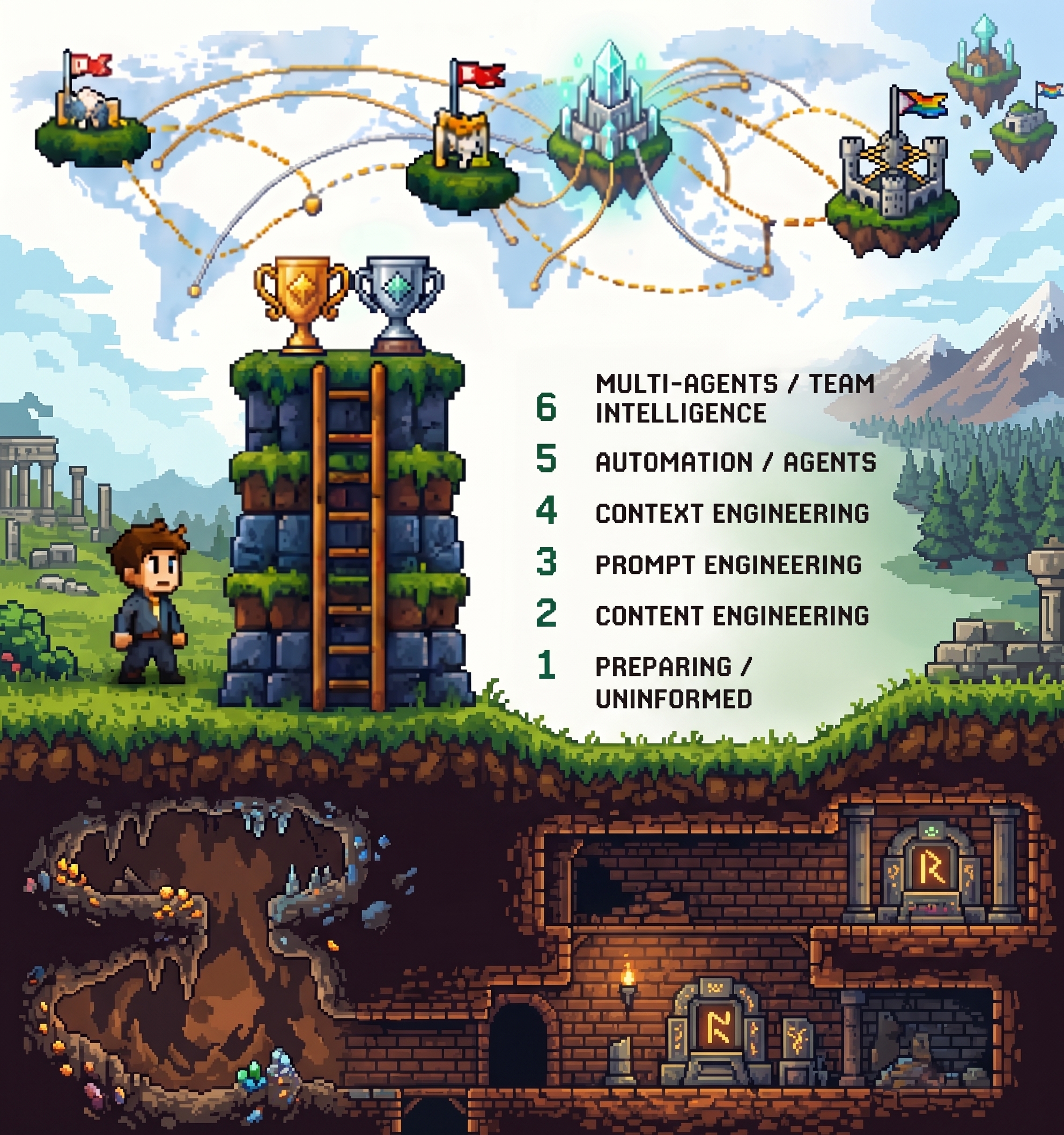
There are basically six levels, to AI adoption in a team or a company: from simple prompting to team intelligence.
| Level | What it means | |
|---|---|---|
 | Prompt engineering | Knowing how to ask AI the right way. |
 | Context engineering | Giving AI memory so it doesn't start from zero. |
 | Automation | Fixed-rule tasks run without you. |
 | Agents | AI adapts and chains actions toward a goal. |
 | Multi-agents | Specialized agents coordinate on complex deals. |
 | Team intelligence | A shared brain that learns from every negotiation, for every negotiator. |

Most negotiation teams sit between level 1 and 3 today — rarely from lack of ambition, but from lack of a method to climb.


The best time to build a negotiation edge was before your last deal. The second best time is now.

WeNego designs and delivers negotiation training and coaching for procurement, sales and commercial teams — turning negotiation into a repeatable, measurable skill rather than a matter of individual talent.
